
CX Operating Model
Why Now May Be the Time to Rebuild Your Customer Contact Centre Operating Model
Whether internal, outsourced, or hybrid, a better contact centre starts with alignment across the customer journey, people, processes, technology, data, and trusted knowledge.

After decades of continuous enhancement of customer experience strategies, billions invested in CX outsourcing partners, massive improvements in recruiting and training processes, growing focus on employee experience, and of course the onslaught of AI-infused technology solutions promising to improve every step of the customer and employee journey...
CX is still under pressure.
According to Forrester’s 2025 Global Customer Experience Index rankings, CX hit an all-time low in North America, while Europe made some gains and Asia Pacific struggled. Globally, 21% of brands declined, 6% improved, and 73% remained statistically unchanged.
So yes, there may be pockets of progress.
But most brands are still stuck.
And stuck is expensive.
Poor customer experience puts brand loyalty at risk. Customers have more options, less patience, and higher expectations than ever. A couple of bad interactions can be enough to push them toward a competitor.
But the opportunity cost may be even higher.
Better customer experience is not just a service metric. It is a revenue, loyalty, and growth issue.
It’s also worth considering Brand Experience - the perception of your brand by prospective customers and current customers before, during, and after they interact with you.
But the real magic happens when you improve both the brand promise and the customer experience at the same time.
That is where Total Experience becomes more than a nice idea.
It becomes an operating model.
So, what is the trick to improving CX and Brand Experience at the same time?
Alignment across teams.
Why CX Is Still Hard in 2026
Anyone who has held any type of leadership position in any organization, in any industry, knows that creating team alignment is one of the biggest challenges facing a business.
Always has been.
Always will be.
Heck, alignment is hard within a single team of six people.
Which only makes it harder when you need alignment across every step of the customer journey - from pre-purchase brand awareness, to sales, to onboarding, to service delivery, to post-purchase support, to retention, to win-back.
Marketing owns the promise.
Sales owns the conversion.
Operations owns delivery.
Customer service owns support.
IT owns the systems.
Finance owns the cost model.
HR owns recruiting, training, and employee experience.
And if you use BPO partners, they may own a major part of the front-line customer interaction.
Then AI gets added on top.
No wonder things get messy.
This is not meant as a knock on CX outsourcing or the BPO industry in any way. I am personally a product of the industry. After spending 30+ years in BPO and CX operations - growing, leading, and creating alignment across teams of thousands of employees throughout North America, LATAM, the Caribbean, and Southeast Asia - I know full well the benefits of outsourcing.
When a brand sets clear expectations, measures performance properly, implements the right technology, optimizes incentives, and partners with the right BPO, CX results can be stronger at a lower cost through outsourcing than through poorly run internal contact centres.
But outsourcing does not remove the need for leadership.
It increases the need for clarity.
And in 2026, clarity matters more than ever.
The Real Question Is Not Insourcing vs. Outsourcing
Too many companies still start with the wrong question.
Should we insource?
Should we outsource?
Should we use AI?
Should we move more work to self-service?
Should we cut cost?
Should we consolidate vendors?
Those questions matter, but they are not the starting point.
The better question is:
What contact centre operating model will best support the customer experience, brand promise, financial goals, people strategy, technology roadmap, and AI readiness of the business?
For some companies, that may mean rebuilding internal capability. For others, it may mean improving the BPO partnership. For many, it will mean a hybrid model where internal teams own the highest-value, most complex, or most brand-sensitive interactions, while outsourced partners support scale, coverage, efficiency, or specialized workflows.
The model is not the strategy.
The model should serve the strategy.
A poorly designed internal contact centre will fail.
A poorly managed outsourced contact centre will fail.
A poorly aligned hybrid model will fail.
The real issue is not where the work sits.
The real issue is whether the work is aligned.
AI Readiness Starts with Alignment
To truly create an aligned experience across brand experience and customer experience, CX teams need to be connected directly to marketing, sales, operations, HR, IT, finance, and leadership.
Not through silos.
Not through filtered reports.
Not through 27 dashboards that do not tell the same story.
Actual alignment.
This becomes even more important when your company is considering AI-enabled or AI-autonomous technologies.
AI can create massive cost savings and revenue opportunities. But it can also create faster, louder, more confident confusion if the operating model underneath it is broken.
Adopting new tools and technology has never been easy.
Any time an organization implements a new technology solution, the entire investment can be wasted if the rollout is not executed properly. If leadership is not listening to the front line, if employees do not understand what is in it for them, and if the process is unclear before the technology is introduced, the implementation is usually in trouble from the start.
AI does not make that easier.
AI needs clean knowledge.
AI needs clear processes.
AI needs trusted data.
AI needs current SOPs.
AI needs strong feedback loops.
AI needs people who know when the answer is right and when it is just confidently wrong.
AI isn’t broken.
Untrusted knowledge is.
If your people cannot consistently follow the process manually, automating that process will not magically make it better.
When you train robots with bad information, you get bad robots.
From Cost Centre to Value Centre
Another major consideration for 2026 is the opportunity to shift the CX contact centre from being viewed only as a cost centre to being managed as a source of customer value, revenue protection, and customer lifetime value.
Most contact centres are still managed primarily through a cost lens.
- Reduce call volume.
- Lower handle time.
- Deflect customers to self-service.
- Move work to lower-cost geography.
- Automate as much as possible.
There is nothing wrong with efficiency. Cost matters. Productivity matters. Automation matters.
But if the contact centre is only managed as a cost centre, the business misses a much bigger opportunity.
Every customer contact is a chance to protect the relationship, improve trust, uncover friction, increase retention, identify revenue opportunities, strengthen the brand promise, and improve customer lifetime value.
That does not mean every support interaction becomes a sales pitch.
It means every contact should be designed around value.
The customer should get value.
The employee should have the tools and knowledge to create value.
The business should receive value from the interaction.
That is a very different operating model than simply trying to make the call shorter or cheaper.
Rebuilding the Contact Centre
Today’s contact centre is a complex mix of integrated people, process, technology, data, and performance management.
Behind every “Contact Us” button, you may find:
- Recruiting, sourcing, and applicant tracking systems to hire the right people.
- Virtual classrooms and learning management systems to onboard effectively and speed up time to proficiency.
- Omnichannel routing and distribution systems to deliver the right conversation from the right channel to the right agent - human or AI.
- CRM platforms for a unified customer view and to track every interaction.
- Workforce management tools for forecasting and scheduling.
- Knowledge management systems that organize customer support processes and provide consistent answers across channels.
- AI-powered autonomous agents and human-agent assist tools that provide next-best-action recommendations, real-time guidance, and customer sentiment insights.
- Interaction analytics to capture and analyze the Voice of the Customer and automate quality assurance.
- Survey tools to capture direct customer feedback.
- Business intelligence dashboards to unify performance data and support informed decisions.
- Performance management, coaching, and gamification systems to drive continuous improvement and employee excellence.
- Security and compliance tools to safeguard customer trust and keep the company protected.
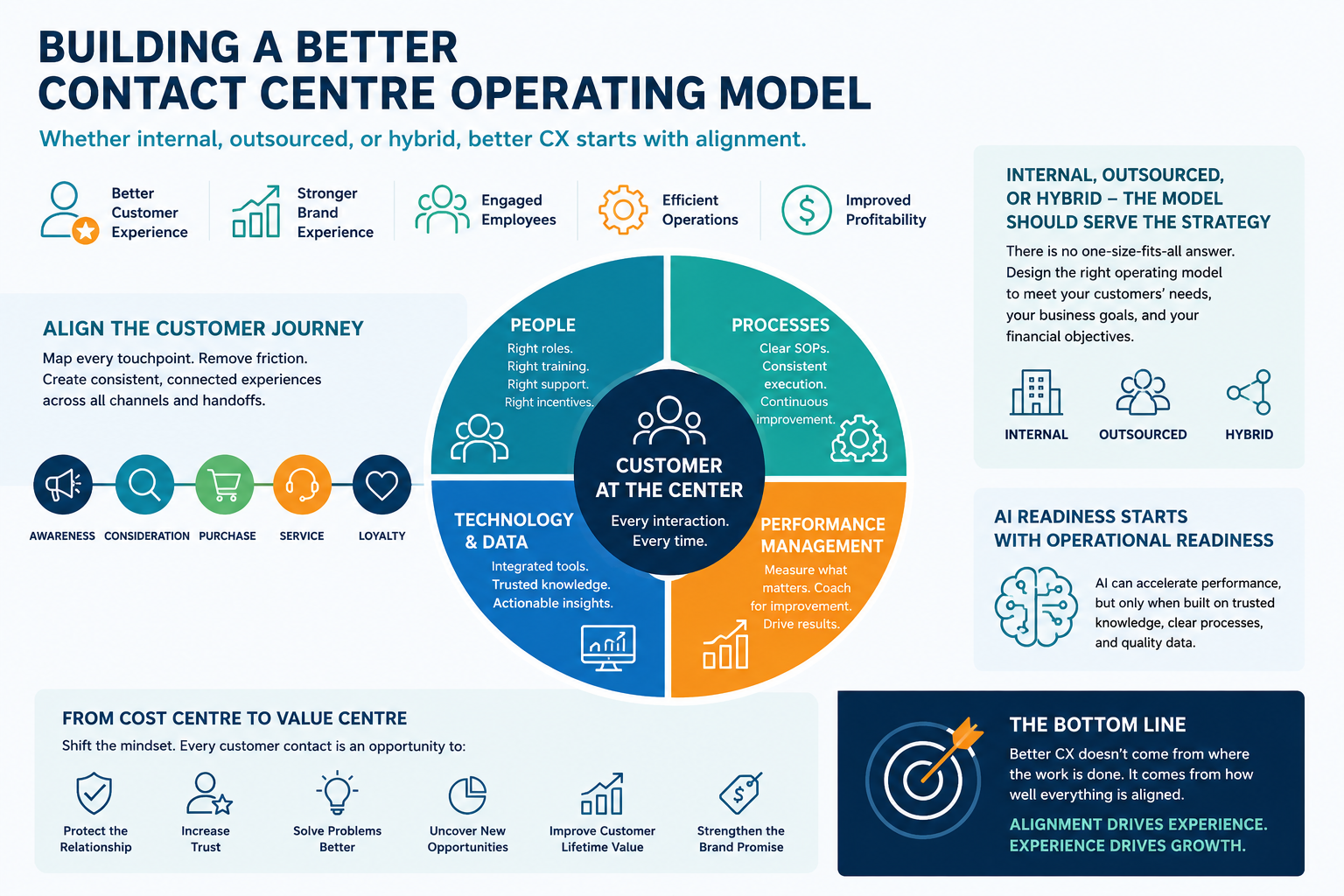
Step one for any successful rebuild is taking stock of the current processes, technology stack, knowledge base, data, spend, people model, and customer journey.
Not every organization needs to automate each component.
Not every organization needs the most advanced version of every tool.
It starts by getting the process defined to match the needs of the business and the customer.
Finding the right mix for your business is what needs to happen.
That means mapping the customer journey from beginning to end.
Mapping the Customer Journey: Your Alignment Blueprint
Creating a complete journey map is not an exercise for the faint of heart, but it is a worthy investment if you want to optimize customer experience, improve brand experience, and create a stronger Total Experience.
Book a full day.
Maybe more, depending on the size and scale of your organization.
Have a whiteboard.
Plenty of sticky notes.
Be prepared to buy lunch.
Designate a facilitator.
Invite the leaders of Marketing, Sales, Operations, Customer Experience, HR, IT, and Finance.
If BPO partners play a meaningful role in the customer journey, include them too.
I would also recommend having your company’s Vision, Mission, Values, and brand promise somewhere noticeably visible in the room for everyone to reference.
Then create a map of every meaningful customer touchpoint - from prospect awareness to lead, sale, onboarding, support, renewal, cancellation, and hopefully winning them back.
For each touchpoint, capture:
- What the touchpoint is and which customer type it serves.
- Why the touchpoint exists and what triggers it.
- What happens, including the channel.
- Who owns it.
- What role handles it.
- What tools, systems, and technology are used.
- What knowledge or SOPs are required.
- How long it should take.
- What the ideal outcome should be.
- How success is measured.
- Where the handoffs occur.
- What can go wrong.
Once the map is completed, documented, and reviewed, you will probably have already identified alignment issues, duplicate work, unclear ownership, weak handoffs, missing knowledge, or technology gaps that need to be corrected.
Take a picture of the map.
Make a digital copy.
Share it with the team.
Give people time to review, challenge, correct, and improve it.
At this point, it should become much clearer where ownership belongs across Marketing, Sales, Operations, CX, HR, IT, Finance, and any BPO partners.
That is where real alignment starts.
The CX Team Deep-Dive Review
Now it is time for the CX leader, along with the leaders of Marketing, Sales, and Operations, to take ownership of their respective touchpoints.
For every touchpoint CX owns, review and confirm:
- Are we doing this consistently today?
- Do we have documented standard operating procedures?
- Are those SOPs current and trusted?
- Is the work measured?
- Do we know the customer pain points?
- Do we know the employee pain points?
- Are the current tools, systems, and technology working well?
- Are handoffs clear?
- What can be removed?
- What can be simplified?
- What can be automated?
- What should not be automated yet?
If your current environment depends heavily on BPO partners, extend the deep dive to them.
Visit your BPO centres.
Do skip-level meetings with front-line supervisors.
Talk separately with agents.
Ask what works.
Ask what does not.
Ask where customers get frustrated.
Ask where the knowledge base is wrong.
Ask where the real answers live.
Whatever you do, validate the feedback from internal teams and BPO partners with the true test of CX.
Review customer surveys.
Inspect speech analytics.
Listen to actual calls.
Read transcripts.
Review QA findings.
Look at escalations, repeat contacts, complaints, and customer churn.
Do not rely on hearsay.
Validate.
Reimagining the People Plan: Hiring to Coaching to Success
Once the customer journey is mapped and CX-owned touchpoints are understood, leadership needs to confirm the roles and responsibilities required to deliver the desired experience.
This applies whether the work is internal, outsourced, or hybrid.
The core people questions are the same.
Environment - should the work be onsite, remote, hybrid, distributed, centralized, or partner-led?
Recruiting - how do we source, screen, and select people who are aligned with the customer experience we need to create?
Training - how do we onboard effectively and efficiently so people understand the customer journey, the brand promise, the tools, the knowledge, the expected behaviours, and the performance expectations?
Support - how do we incentivize, coach, develop, and support people so they can succeed while improving both customer experience and employee experience?
Measurement - how do we provide consolidated reporting that helps leaders make informed decisions and helps employees understand what good performance actually looks like?
A contact centre cannot outperform the quality of its coaching system for long.
And no amount of AI will fix a team that has unclear expectations, weak knowledge, poor coaching, or misaligned incentives.
Only once you have done this across the customer journey should you aggressively pursue automation and AI-based cost savings.
If your processes cannot be implemented consistently with people, they will likely create even more chaos when automated.
Cost Planning: Making the Business Case
So cool, now we have a better CX journey, a clearer people plan, a better view of the technology stack, and a stronger understanding of where AI may actually help.
But what is the impact to the bottom line?
How are we going to make sure this makes financial sense?
First things first, capture the current total cost and cost per contact of your CX operation.
Include every current dollar being spent on BPOs, internal teams, leadership, vendor management, workforce planning, quality, training, reporting, escalations, technology, rework, churn, and missed revenue opportunities.
Then compare that to the costs associated with the future model.
Depending on the strategy, that may include:
- Talent acquisition.
- Training and onboarding.
- Pay, benefits, and incentives.
- Facilities.
- Technology infrastructure.
- Software and AI tools.
- Leadership.
- Workforce planning.
- Reporting.
- Ongoing coaching and development.
- Vendor management.
- Transition costs.
Then tie the investment to expected business outcomes:
- Improved first-contact resolution.
- Reduced repeat contacts.
- Lower escalation volume.
- Improved customer satisfaction.
- Reduced churn.
- Increased retention.
- Increased revenue per contact.
- Improved customer lifetime value.
- Reduced rework.
- Better compliance.
- Better employee retention.
- Stronger performance consistency.
No contact centre strategy is complete without a detailed financial business case.
The goal is not simply to spend less.
The goal is to create more value than the operating model costs.
Bringing It All Together: Total Experience, Real Results
To quote Peter Drucker, “If you fail to plan, you are planning to fail.”
But as former heavyweight champ Mike Tyson also stated, “Everyone has a plan until they get punched in the mouth.”
Both are true.
You need a plan.
You also need the ability to adjust when reality hits.
That is why a better contact centre operating model needs both structure and feedback.
The structure comes from clear ownership, mapped customer journeys, current SOPs, trusted knowledge, aligned tools, defined roles, useful scorecards, strong coaching systems, and clear financial targets.
The feedback comes from customers, front-line employees, supervisors, QA, speech analytics, surveys, performance reviews, BPO partners, and leadership operating rhythms.
When the structure and feedback loops are working, the business can improve continuously.
When they are broken, the business just reacts to symptoms.
Whether you are considering insourcing your contact centre, optimizing your existing outsourced services, building a hybrid model, or preparing your operation for AI, customer expectations have changed.
AI expectations have changed.
Employee expectations have changed.
The contact centre needs to change with them.
Tomorrow’s winners in CX will not simply be the companies with the newest tools, the cheapest labour, or the flashiest AI demo.
They will be the companies that connect and align every step of the customer and employee journey.
Not just for service.
For value.
For trust.
For growth.
For Total Experience.